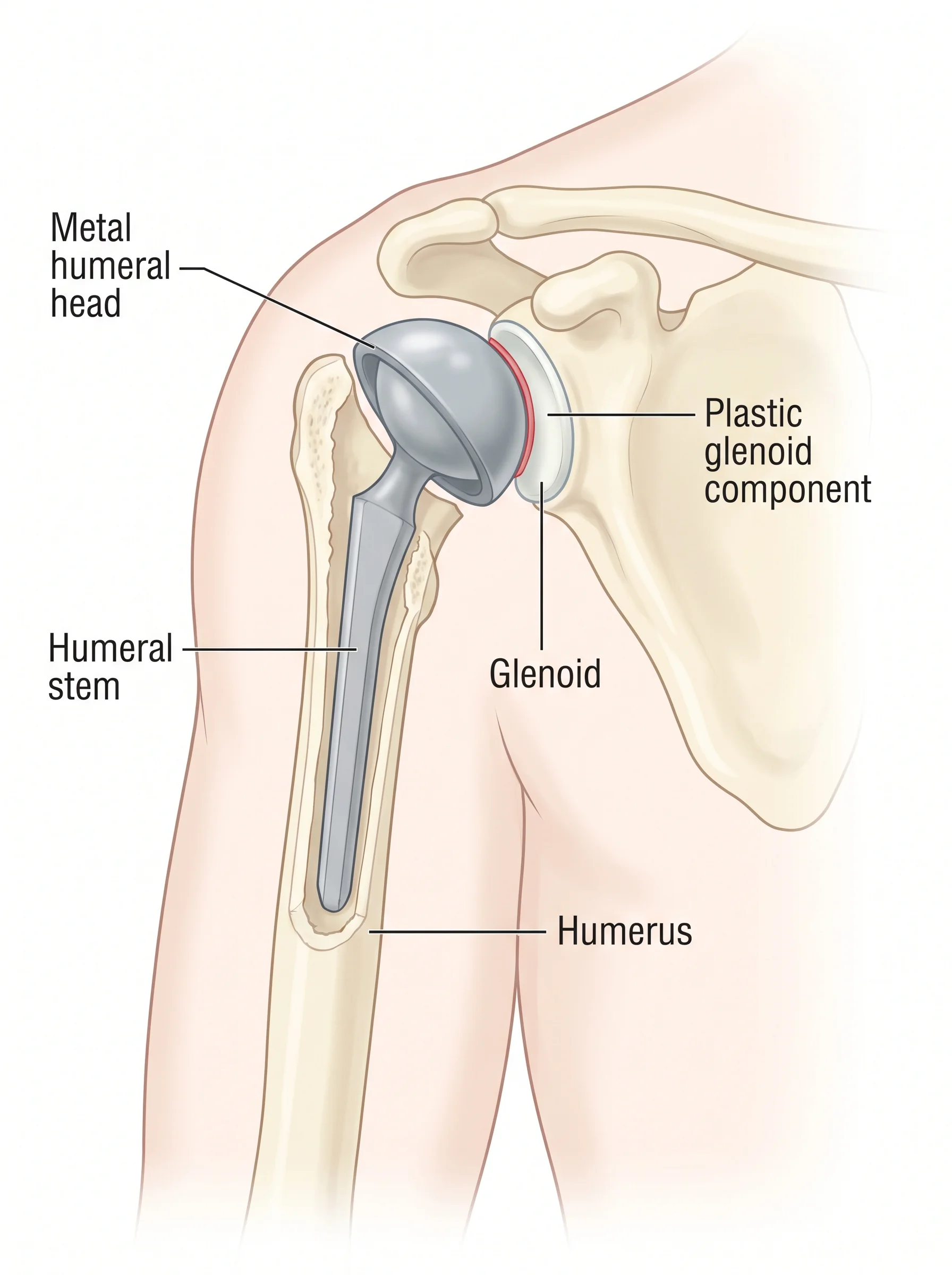
Total shoulder replacement is surgery that replaces the worn ball and socket of the shoulder with smooth artificial parts. It is used mainly for shoulder arthritis when pain and stiffness continue despite non-surgical care. It relieves pain and restores motion for most patients. Recovery is gradual and measured in months.
Ryan Simovitch performs total shoulder replacement in West Palm Beach when it is the right step, and reviews every alternative with you first.
What is total shoulder replacement, and who is it for?
Total shoulder replacement is a procedure that removes the damaged surfaces of the shoulder joint and replaces them with a smooth metal ball and a plastic socket.
The shoulder is a ball-and-socket joint. The ball is the upper end of the arm bone, and the socket is part of the shoulder blade. When the cartilage (the smooth cushion covering the bone ends) wears away, bone rubs on bone, which causes pain and stiffness.
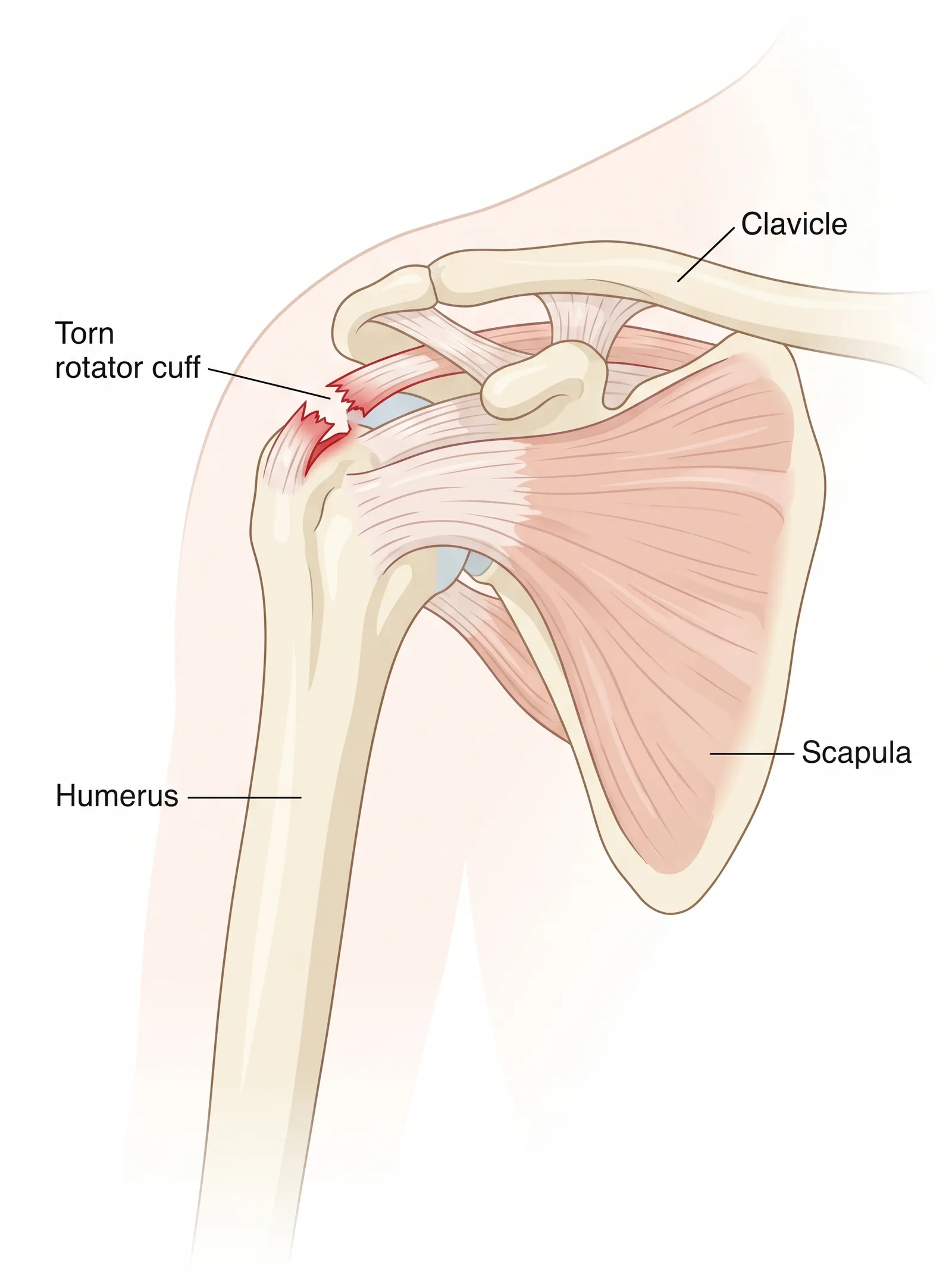
The most common reason for this surgery is osteoarthritis, the gradual wear of cartilage with age. Other reasons include arthritis after an old injury and rheumatoid arthritis, a disease in which the immune system inflames the joint lining. Standard total shoulder replacement works well when the rotator cuff, the group of tendons that move and steady the shoulder, is still healthy enough to power the new joint. When the cuff is badly torn or worn, a different design called reverse shoulder replacement is often used instead, and that procedure has its own page.
This page explains what shoulder arthritis feels like, how it is diagnosed, the non-surgical care that comes first, and what the surgery and recovery involve if replacement becomes the right choice.
What do the symptoms feel like, and when should you see a specialist?
The main symptoms that lead to shoulder replacement are deep shoulder pain and stiffness that limit daily life despite other treatment.
Patients often describe.
- A deep, aching pain in the shoulder that worsens with activity and, over time, at rest. - Stiffness that makes it hard to reach overhead, behind the back, or across the body. - Pain at night that disturbs sleep. - A grinding or catching feeling as the roughened surfaces move. - Trouble with everyday tasks like dressing, washing hair, or reaching a shelf.
These symptoms usually build slowly over months to years. It is reasonable to see a shoulder specialist when pain and stiffness limit the activities you care about, when sleep is disrupted, or when non-surgical care is no longer keeping up. A specialist can confirm whether arthritis is the cause and whether the rotator cuff is intact, which shapes the treatment plan. This page describes patterns and does not diagnose. Only an in-person exam and imaging can determine the cause.
How is shoulder arthritis diagnosed?
Diagnosis combines your history, a physical exam, and imaging.
The visit starts with questions about how long the pain has been present, what makes it worse, and how it affects motion, sleep, and daily tasks.
The exam checks how far the shoulder moves, where it hurts, and how strong it is. The surgeon also tests the rotator cuff, because whether the cuff is intact affects which type of replacement fits most appropriately.
Imaging confirms the diagnosis. X-rays show the joint space, and in arthritis they often show the cushion narrowed or gone, along with bone spurs and changes in the bone. When more detail about the rotator cuff or bone shape is needed, the surgeon may order an MRI or a CT scan (a detailed X-ray-based image). A CT scan helps plan the placement of the new socket. These findings, with your exam, tell the surgeon whether replacement is appropriate and which design fits your shoulder.
[CTA: To have shoulder arthritis evaluated, request a visit with Dr. Simovitch. Contact details are on the contact page.]
What happens during Total Shoulder Replacement, step by step?
Total shoulder replacement removes the worn ball and socket and replaces them with a metal ball and a plastic socket.
It is done through an incision at the front of the shoulder.
- Anesthesia. You receive anesthesia so you feel no pain, often a nerve block that numbs the arm along with general anesthesia. The anesthesia team reviews the plan with you. - Reaching the joint. The surgeon makes an incision at the front of the shoulder and carefully moves the muscles aside to reach the joint without cutting through the rotator cuff. - Preparing the ball. The worn upper end of the arm bone is removed and shaped to hold a metal ball, which is fixed to a stem set into the arm bone. - Preparing the socket. The worn socket surface is smoothed and fitted with a smooth plastic cup that is secured in place. - Setting the joint. The new ball and socket are brought together, and the surgeon checks that the shoulder moves smoothly and is stable. - Closing. The muscles are repaired, the incision is closed, and the arm is placed in a sling.
Total shoulder replacement usually involves a short hospital stay of a day or so, though some patients go home the same day depending on their health and their surgeon's plan. The care team will tell you what to expect for your case.
What is the recovery timeline for Total Shoulder Replacement?
Recovery from total shoulder replacement is gradual and measured by what you can do as much as by the calendar.
The stages below give milestones alongside typical ranges. These are ranges, not promises. Your timeline depends on your health before surgery, the condition of your tissues, and your rehabilitation.
Early recovery (roughly the first 2 to 6 weeks). The incision heals and the repaired muscles begin to recover. You wear a sling and start gentle motion as directed, often with a therapist moving the arm at first. Milestone: you can manage the sling, sleep in a supported position, and do gentle motion without sharp pain.
Restoring motion (roughly 6 to 12 weeks). You gradually move the arm under your own power. Milestone: you can raise the arm through more of its range and handle light daily tasks below shoulder height.
Rebuilding strength (roughly 3 to 6 months). With tissues healed, therapy adds resistance to rebuild strength. Milestone: you regain useful strength for everyday lifting and reaching, and pain from arthritis is much improved.
Full recovery (often up to a year). Continued gains in strength and motion happen over many months. According to general guidance from the American Academy of Orthopaedic Surgeons, recovery of comfortable function after shoulder replacement commonly takes several months, with improvement continuing up to about a year. These are ranges, not promises. Your surgeon and therapist will guide the pace and any limits on heavy overhead activity.
Read the full guide to preparing for surgery →
Your own recovery instructions come from the office and are specific to you. This page describes the general course, not a plan to follow.
How should you prepare for surgery?
Planning ahead makes recovery easier, because your operated arm will be in a sling and limited for several weeks.
Use the time before surgery to get ready.
At home. Set everyday items at waist to chest height. Stock simple meals. Lay out loose, front-opening shirts, which are far easier than pullovers with a sling. A recliner or wedge pillow helps many people sleep more comfortably than lying flat.
Transportation. Arrange a ride home and rides to early appointments. You cannot drive while in the sling or while taking medicine that causes drowsiness. Your surgeon will say when driving is safe again.
Time off. Plan work time based on your job. Desk work often resumes within a few weeks with the arm supported, while jobs that require lifting or overhead reach need much longer. Ask your surgeon for guidance specific to your work.
Help on hand. Arrange for someone to stay with you for the first few days to help with meals, dressing, bathing, and household tasks that need two hands.
Health prep. Follow all instructions about medicines to stop or continue and about not eating or drinking before surgery. Your team may ask you to complete a medical check-up beforehand to make sure you are ready. If you use tobacco, reducing it before surgery supports healing.
Which warning signs should you call about?
Most recoveries are smooth, but some signs need a prompt call to the surgical office.
Call the office if you have.
- Fever, chills, or spreading redness and warmth around the incision, which can signal infection. - Drainage of pus or a foul smell from the incision. - Pain that suddenly worsens and is not eased by your prescribed medicine. - Numbness, tingling, or fingers that turn pale or blue and do not improve with position changes. - A shoulder that feels like it has shifted or will not move as it did. - Calf pain or swelling, or new shortness of breath or chest pain.
New shortness of breath, chest pain, or a swollen, painful calf can signal a blood clot and is a reason to seek emergency care right away by calling your local emergency number. For questions about the incision, the sling, medicine, or activity, call the surgical office, and use the on-call number after hours. It is always fine to call with a question.
What results can you expect from Total Shoulder Replacement?
Total shoulder replacement is a reliable way to relieve arthritis pain and restore motion for most patients.
According to general guidance from the American Academy of Orthopaedic Surgeons, most people who have shoulder replacement for arthritis experience significant pain relief and improved use of the shoulder. Results depend on the health of the rotator cuff and surrounding tissue and on rehabilitation.
Modern shoulder replacements are durable, and many continue to function well for many years, according to general orthopaedic literature summarized by the American Academy of Orthopaedic Surgeons. Like any joint replacement, the parts can wear or loosen over time, and a small number of patients may need further surgery later. Your surgeon can explain what the condition of your shoulder means for your likely result and how long a replacement is expected to last. These are general ranges, not promises for any one person.
What do patients ask most?
How long will I stay in the hospital?+
How long will I wear the sling?+
What is the difference between total and reverse shoulder replacement?+
When can I drive again?+
How long does a shoulder replacement last?+
What will it cost?+
What are the treatment options?
- 01Activity changesAdjusting how you do painful tasks, and pacing activity, can lower daily pain.
- 02Physical therapyGentle exercises maintain motion and strengthen the muscles around the shoulder, which supports the joint.
- 03Anti-inflammatory medicineOver-the-counter or prescribed medicine can ease pain and swelling. Ask a pharmacist or physician what is safe for you.
- 04InjectionsA cortisone injection into the joint can reduce inflammation and provide relief for a period of time.
- 05Heat, ice, and restduring flares can help manage day-to-day discomfort.
Fellowship trained at Massachusetts General Hospital (Harvard Shoulder Service); Uniklinik Balgrist, Zurich, Switzerland (The Harvard Intercontinental Shoulder Fellowship). Sees patients in West Palm Beach.
About Dr. Simovitch →