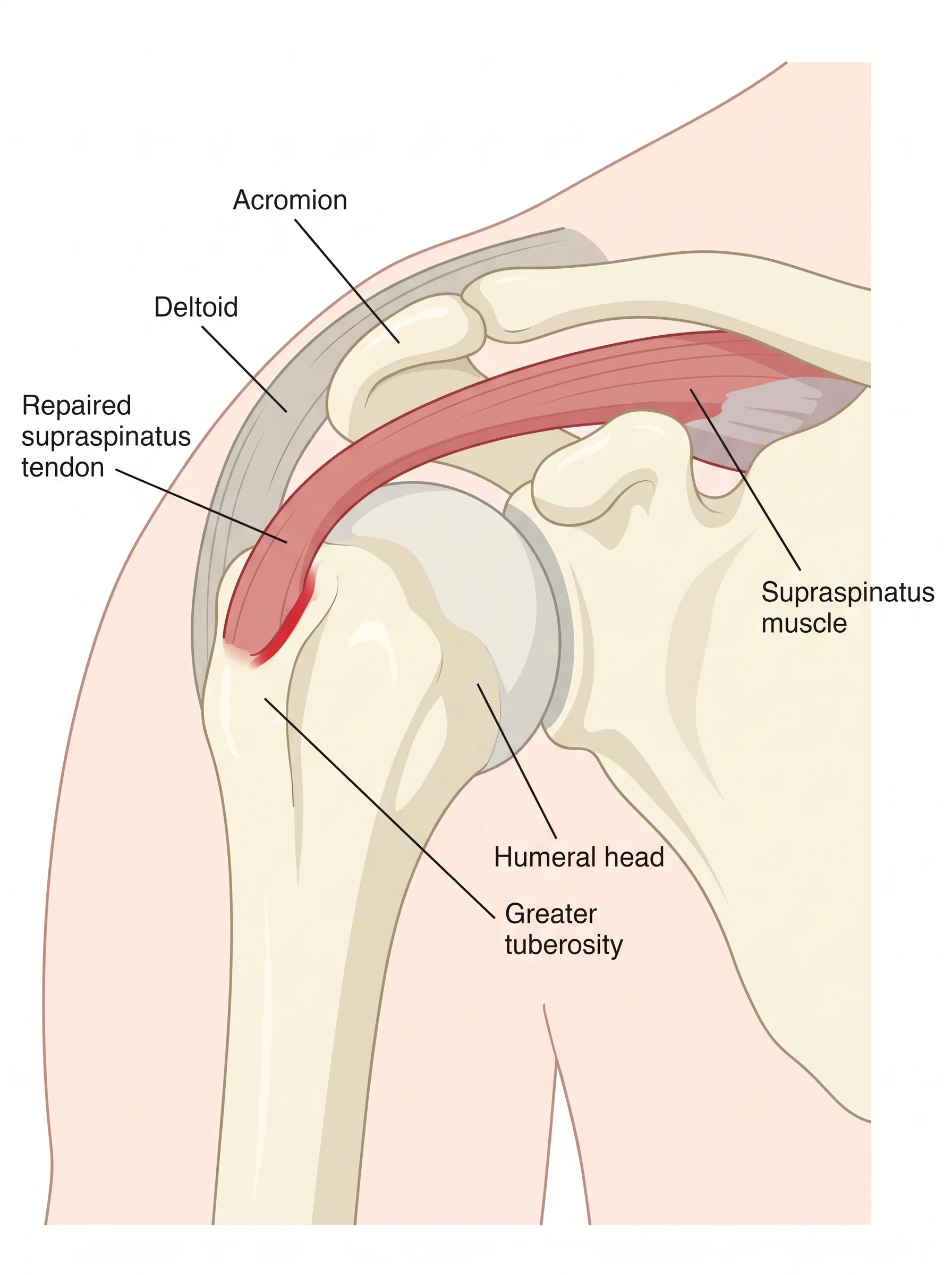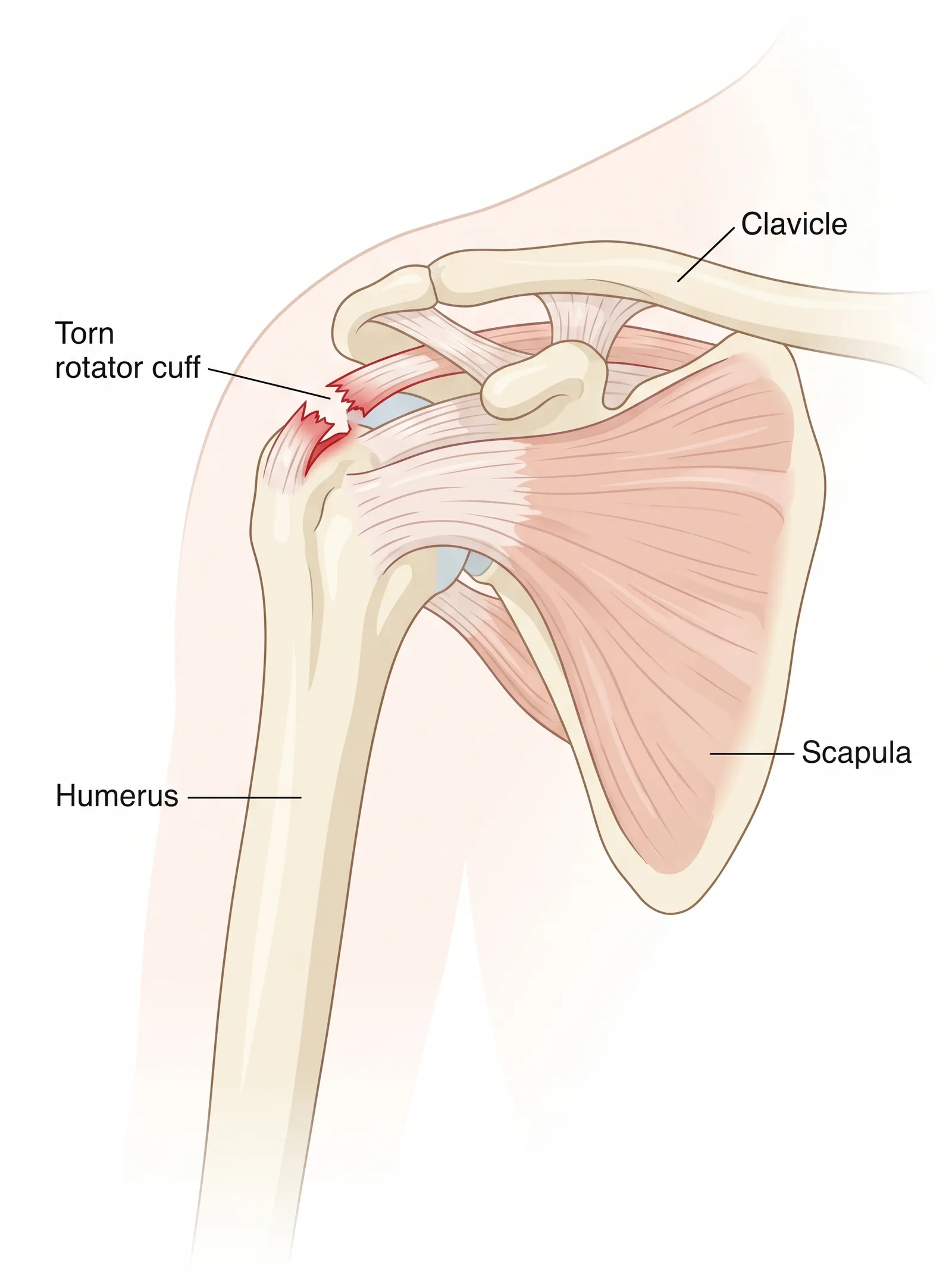
A rotator cuff tear is damage to the group of muscles and tendons that hold the shoulder in its socket and lift the arm. Dr. Simovitch evaluates and treats rotator cuff tears in West Palm Beach, starting with rest, therapy, and injections, and offering surgical repair when non-surgical care does not restore comfort and strength.
Ryan Simovitch diagnoses and treats rotator cuff tear in West Palm Beach, from the first visit through recovery.
What is Rotator Cuff Tear?
The rotator cuff is a group of four muscles and their tendons, the ropelike tissue that attaches muscle to bone, that surround the top of the arm bone.
Together they hold the ball of the shoulder in its socket and let you raise and rotate your arm. A tear means one of these tendons has pulled partly or fully away from the bone.
Tears happen two ways. Some come on slowly as the tendon wears thin with age or repeated overhead use, and are called degenerative tears. Others happen suddenly, from a fall onto an outstretched arm or lifting something heavy, and are called acute tears.
Common signs are pain on the outside of the shoulder, pain that is worse at night or when lying on that side, weakness when lifting or reaching overhead, and a dull ache that makes it hard to sleep. Some tears cause little pain, so weakness alone is worth having checked.
How is Rotator Cuff Tear diagnosed, and what does the visit involve?
A rotator cuff tear is diagnosed by an exam and imaging.
Dr. Simovitch will ask how the pain started, then test the shoulder's strength and motion with the arm in set positions. X-rays show the bones and can reveal changes that go with cuff problems, though they do not show the tendon itself. An MRI, a scan that pictures soft tissue, or an ultrasound confirms whether a tendon is torn, how large the tear is, and whether the muscle has weakened over time. That detail guides whether therapy or repair fits the situation.
What can I expect over time?
Living with a rotator cuff tear often means steady, gradual progress rather than a sudden fix.
Many people regain comfort and function through the treatment ladder above, especially physical therapy that strengthens the muscles around the shoulder to share the load. Some tears stay stable while others slowly enlarge, so it helps to check back with Dr. Simovitch if pain or weakness returns, worsens, or does not improve after a few months of non-surgical care.
What do patients ask most?
Can a rotator cuff tear heal on its own?+
How do I know if my shoulder pain is a rotator cuff tear or something else?+
Is surgery always needed for a rotator cuff tear?+
What happens if a rotator cuff tear is left untreated?+
What are the treatment options?
- 01Rest and activity changes, meaning a short break from overhead motions that trigger painRest and activity changes, meaning a short break from overhead motions that trigger pain.
- 02Physical therapy to strengthen the shoulder and the muscles around it, which often restorePhysical therapy to strengthen the shoulder and the muscles around it, which often restores function even when a tear remains.
- 03Anti-inflammatory medicine to lower pain and swellingAnti-inflammatory medicine to lower pain and swelling.
- 04A corticosteroid injection, a shot that reduces inflammation, to calm pain enough to do thA corticosteroid injection, a shot that reduces inflammation, to calm pain enough to do therapy.
- 05Surgical rotator cuff repair, considered when pain and weakness continue after months of nSurgical rotator cuff repair, considered when pain and weakness continue after months of non-surgical care, or for larger tears in active patients.
Fellowship trained at Massachusetts General Hospital (Harvard Shoulder Service); Uniklinik Balgrist, Zurich, Switzerland (The Harvard Intercontinental Shoulder Fellowship). Sees patients in West Palm Beach.
About Dr. Simovitch →