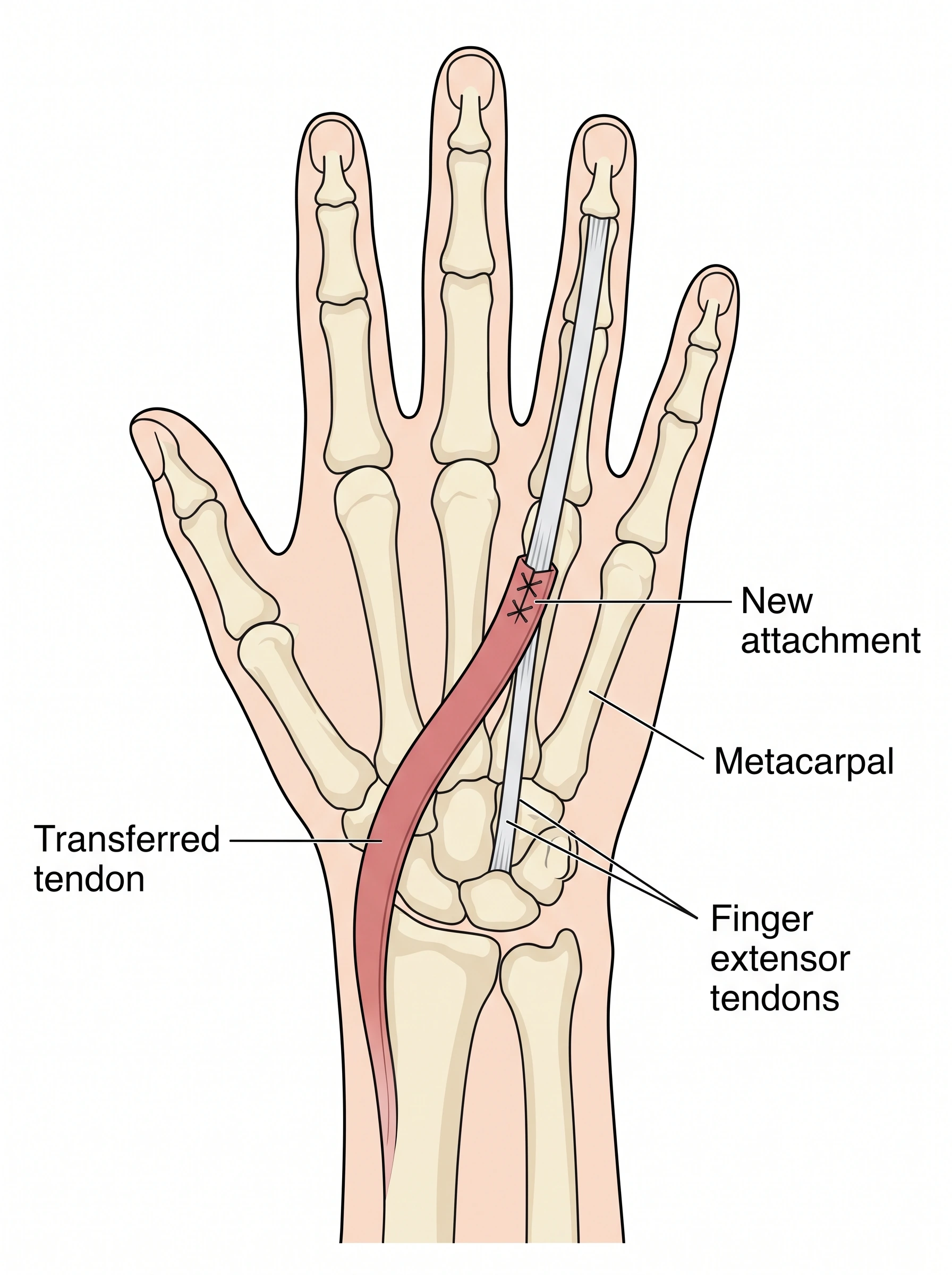
A tendon transfer moves a working tendon to a new job, so it can do the work of a muscle that no longer works. Dr. Simovitch performs tendon transfers in West Palm Beach for hands weakened by nerve injury, tendon rupture, or rheumatoid disease.
Ryan Simovitch performs tendon transfer in West Palm Beach when it is the right step, and reviews every alternative with you first.
What is a tendon transfer?
Every movement of the hand comes from a muscle pulling on a tendon.
That chain can break in two places. The nerve that drives the muscle can be injured, so a healthy muscle gets no signal. Or the tendon can rupture, worn through by a rough bone edge or by the inflamed lining of a rheumatoid joint. A torn tendon is stitched when it can be, and a nerve that may recover is given time. Sometimes neither works, and the movement is gone: the wrist drops, a finger will not straighten, the thumb will not pinch.
A tendon transfer is the way around that. A tendon that still works is detached from the bone it moves, rerouted, and stitched onto the tendon that has failed. Its muscle keeps its own nerve and blood supply, and pulls on something new.
The trade is real. One function is borrowed to restore another, so the donor comes from movements the hand can spare, usually one a second muscle also performs. It has to be strong enough and pull in roughly the right direction. One donor does one job.
What happens during a tendon transfer?
A transfer is done under a regional block that numbs the arm with sedation, or a general anesthetic, usually as an outpatient.
Incisions are made over the donor tendon and over the tendon that needs help. The donor is cut free from where it attaches, then passed under the skin, or through a window in the tissue between the forearm bones, to reach its new position in a straight line. It is threaded through the receiving tendon two or three times and stitched. Setting the tension is the delicate part: too loose and nothing moves, too tight and the finger will not open. The surgeon sets it with the wrist in a chosen position and checks that the fingers fall into a natural cascade. Most transfers take one to three hours, and a cast or splint is applied at the end.
What is recovery like after a tendon transfer?
The hand is held in a cast or splint for about three to four weeks, then therapy begins.
Re-learning is part of recovery, and it surprises people. At first you may have to think of the tendon's old job to get the new movement, so a transfer that now straightens the fingers may only fire when you think about bending your wrist. With practice the link becomes direct over weeks, and automatic over months.
Strength after a transfer is usually less than the original muscle had, and the aim is useful function, not a normal hand. Light use commonly returns at six to eight weeks and heavier work at three months or more, with the final picture at six months to a year. These are ranges, not promises.
Read the full guide to preparing for surgery →
Your own recovery instructions come from the office and are specific to you. This page describes the general course, not a plan to follow.
What do patients ask most?
What do I lose by giving up the donor tendon?+
Why not repair the nerve instead?+
Will the movement feel normal?+
Is this used for rheumatoid tendon ruptures?+
What are the treatment options?
- 01Time and watching, when an injured nerve may still recoverTime and watching, when an injured nerve may still recover
- 02Hand therapy and splinting to keep the joints loose, since a stiff joint cannot be helpedHand therapy and splinting to keep the joints loose, since a stiff joint cannot be helped by a transfer
- 03A brace that stands in for the lost movement, such as a wrist splintA brace that stands in for the lost movement, such as a wrist splint
- 04Direct repair or grafting of the injured nerve or tendon, where possibleDirect repair or grafting of the injured nerve or tendon, where possible
- 05Tendon transfer when the muscle will not come back, or repair is no longer an optionTendon transfer when the muscle will not come back, or repair is no longer an option
Fellowship trained at Massachusetts General Hospital (Harvard Shoulder Service); Uniklinik Balgrist, Zurich, Switzerland (The Harvard Intercontinental Shoulder Fellowship). Sees patients in West Palm Beach.
About Dr. Simovitch →