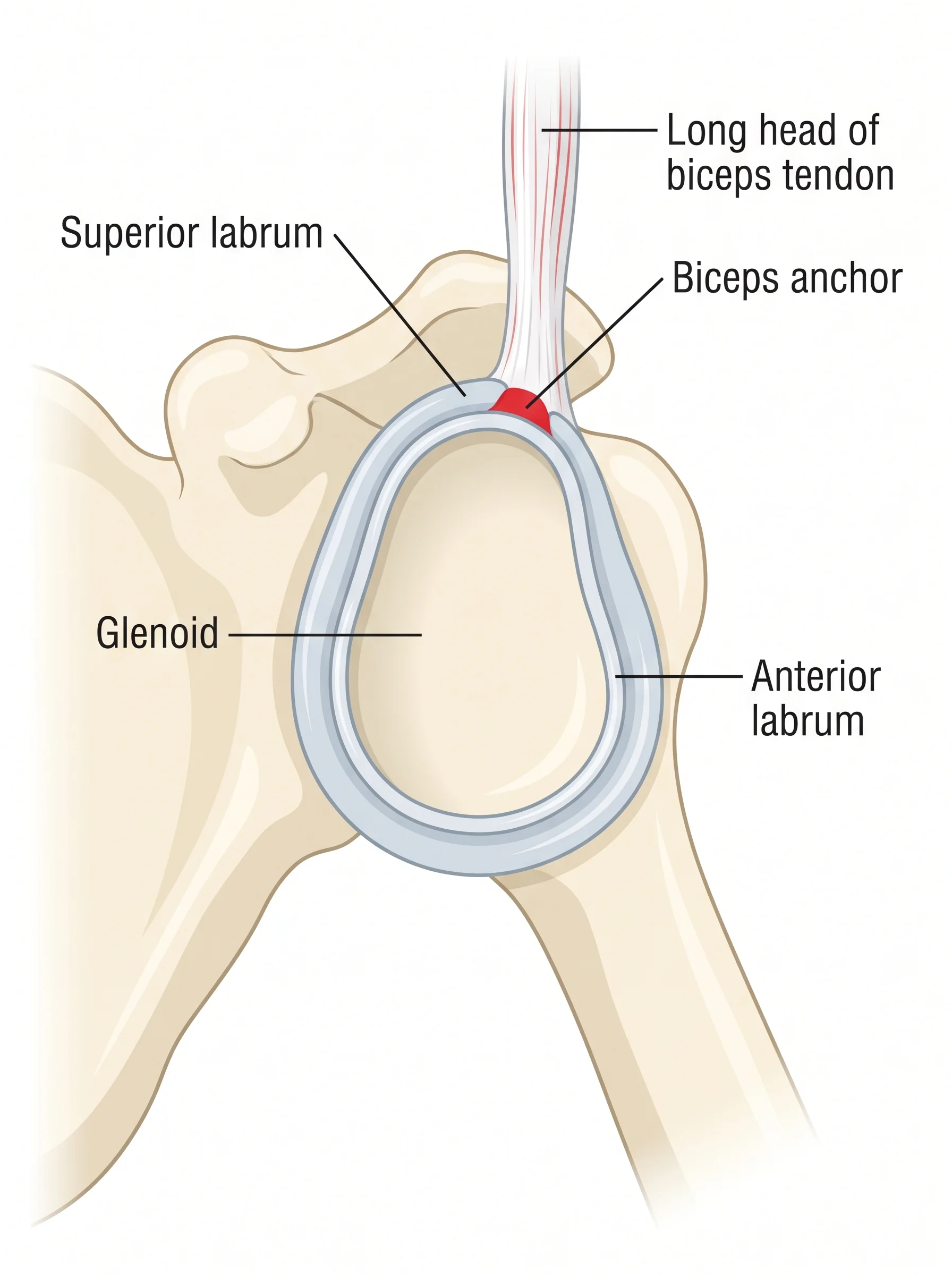
Shoulder labral repair, often called SLAP repair, reattaches a torn rim of cartilage in the shoulder socket. Surgeons do it with a small camera and thin instruments through tiny cuts. It is considered for certain tears when pain, catching, or instability continue despite therapy. Recovery is gradual and measured in months.
Ryan Simovitch performs shoulder labral / slap repair in West Palm Beach when it is the right step, and reviews every alternative with you first.
What is SLAP repair, and who is it for?
Shoulder labral repair is a procedure that reattaches a torn part of the labrum, the rim of cartilage that lines and deepens the shoulder socket.
The labrum acts like a gasket around the shallow socket, adding depth and helping keep the ball of the arm bone centered. It is also where the biceps tendon (the cord from the muscle at the front of the upper arm) attaches at the upper rim of the socket.
A SLAP tear is a specific kind of labral tear. The letters stand for superior labrum anterior to posterior, which describes a tear at the upper part of the labrum that runs from front to back near where the biceps tendon attaches. These tears can happen from a fall onto an outstretched arm, from repeated overhead motion such as throwing, or from gradual wear with age.
Not every labral tear needs surgery. Many improve with rest and therapy, and some age-related changes cause no symptoms at all. SLAP repair is considered for active patients with a clear tear that keeps causing pain, catching, or a sense of instability despite non-surgical care. In some patients, especially older adults or those with wear at the biceps attachment, a different procedure that manages the biceps tendon is preferred over repairing the labrum. This page explains what these tears feel like, how they are diagnosed, the non-surgical care that comes first, and what surgery and recovery involve.
What do the symptoms feel like, and when should you see a specialist?
The common symptoms of a SLAP tear are deep shoulder pain, catching or popping, and a feeling that the shoulder is loose, especially with overhead motion.
Patients often describe.
- A deep ache inside the shoulder, hard to point to exactly. - Pain with overhead activity, throwing, or reaching back. - A catching, popping, or clicking feeling deep in the joint. - A sense that the shoulder is loose or might slip. - Loss of power or accuracy in throwing or overhead sports.
Symptoms can be vague and are easy to confuse with other shoulder problems, which is one reason a specialist evaluation matters. It is reasonable to see a shoulder specialist when deep shoulder pain lasts more than a few weeks despite rest and therapy, when the shoulder catches or feels unstable, or when overhead athletes lose strength or control. Sudden pain after a fall onto the arm is also worth evaluating. This page describes patterns and does not diagnose. An in-person exam and imaging are needed to find the cause.
How is a SLAP tear diagnosed?
Diagnosis combines your history, a physical exam, and imaging, and it can take care because these tears are hard to pin down.
The visit begins with questions about how the pain started, what activities trigger it, and whether the shoulder catches or feels loose.
The exam uses several specific tests that load the upper part of the labrum and the biceps attachment to try to reproduce the pain and catching. No single test is perfect, so surgeons combine the findings.
Imaging helps confirm the tear. X-rays show the bones and rule out other problems but do not show the labrum. An MRI shows soft tissue, and to see the labrum clearly a surgeon often orders an MRI arthrogram, in which a dye is placed in the joint before the scan to outline a tear. Even with good imaging, the final confirmation of a SLAP tear is sometimes made during arthroscopy, when the surgeon can see and probe the labrum directly. Your exam and imaging together guide the plan.
[CTA: To have deep shoulder pain evaluated, request a visit with Dr. Simovitch. Contact details are on the contact page.]
What happens during Shoulder Labral / SLAP Repair, step by step?
SLAP repair reattaches the torn upper part of the labrum to the socket using small anchors and sutures, and it is done arthroscopically with a small camera and thin instruments.
- Anesthesia. You receive anesthesia so you feel no pain, often a nerve block that numbs the arm along with sedation or general anesthesia. The anesthesia team reviews the plan with you. - Camera and inspection. The surgeon makes a small cut and inserts the arthroscope, which sends a magnified view to a screen. Saltwater fluid expands the joint for a clear view, and the surgeon confirms the tear and its pattern. - Preparing the site. The surgeon clears frayed tissue and prepares the rim of the socket where the labrum will reattach so it can heal. - Placing anchors. Small anchors are set into the bone at the edge of the socket. These hold strong sutures. - Reattaching the labrum. The sutures are passed around the torn labrum and tied down, securing it back against the socket. If the plan is to treat the biceps tendon instead, the surgeon releases or reattaches the biceps at a different spot rather than repairing the labrum. - Closing. The small cuts are closed, a dressing is applied, and the arm is placed in a sling.
SLAP repair is usually outpatient, meaning you go home the same day. The exact steps depend on what the surgeon finds and the plan you agreed on beforehand.
What is the recovery timeline for Shoulder Labral / SLAP Repair?
Recovery from SLAP repair is gradual, because the labrum must heal to bone before it is stressed.
The stages below give milestones alongside typical ranges. These are ranges, not promises. Your timeline depends on the tear, whether the biceps was addressed, your health, and your rehabilitation.
Stage 1, protect the repair (roughly the first 4 to 6 weeks). The goal is to let the labrum begin healing. You wear a sling, and motion is limited at first, often with the therapist moving the arm for you. Milestone: you can manage the sling, sleep supported, and do gentle protected motion without sharp pain.
Stage 2, restore motion (roughly 6 to 12 weeks). You gradually move the arm under your own power without added load. Milestone: you can raise the arm through more of its range and handle light daily tasks.
Stage 3, rebuild strength (roughly 3 to 4 months). With the repair healed, therapy adds resistance to rebuild strength and control. Milestone: you regain strength for everyday reaching and lifting.
Stage 4, return to sport and overhead activity (often 4 to 9 months, sometimes longer for throwers). Return to throwing and overhead sports is the last and slowest step, and overhead athletes usually follow a staged throwing program. According to general guidance from the American Academy of Orthopaedic Surgeons, return to full overhead sports after labral repair commonly takes several months to a year, and throwing athletes vary widely in their return. These are ranges, not promises. Your surgeon and therapist will guide the pace.
Read the full guide to preparing for surgery →
Your own recovery instructions come from the office and are specific to you. This page describes the general course, not a plan to follow.
How should you prepare for surgery?
Planning ahead makes the first weeks easier, because your arm will be in a sling and limited.
Use the time before surgery to get ready.
At home. Set everyday items at waist to chest height. Stock simple meals. Lay out loose, front-opening shirts, which are easier than pullovers with a sling. A recliner or wedge pillow helps many people sleep.
Transportation. Arrange a ride home and rides to early appointments. You cannot drive while in the sling or while taking medicine that causes drowsiness. Your surgeon will say when driving is safe again.
Time off. Plan work time based on your job. Desk work often resumes within a couple of weeks with the arm supported, while physical or overhead jobs need much longer. Athletes should expect a staged return over months. Ask your surgeon for guidance specific to your situation.
Help on hand. Have someone available for the first few days to help with meals, dressing, and tasks that need two hands.
Health prep. Follow all instructions about medicines to stop or continue and about not eating or drinking before surgery. If you use tobacco, reducing it before surgery supports healing.
Which warning signs should you call about?
Most recoveries go well, but some signs need a prompt call to the surgical office.
Call the office if you have.
- Fever, chills, or spreading redness and warmth around a cut, which can signal infection. - Drainage of pus or a bad smell from an incision. - Pain that suddenly worsens and is not eased by your prescribed medicine. - Numbness, tingling, or fingers that turn pale or blue and do not improve with position changes. - A shoulder that feels like it has slipped or come out of place. - Calf pain or swelling, or new shortness of breath or chest pain.
New shortness of breath, chest pain, or a swollen, painful calf can signal a blood clot and is a reason to seek emergency care right away by calling your local emergency number. For questions about the incision, the sling, medicine, or activity, call the surgical office, and use the on-call number after hours. It is always fine to call with a question.
What results can you expect from Shoulder Labral / SLAP Repair?
SLAP repair relieves pain and improves function for most well-selected patients, though recovery is slow and return to overhead sport varies.
According to general guidance from the American Academy of Orthopaedic Surgeons, most patients who have labral repair for a symptomatic tear report reduced pain and better shoulder function. Results depend on the tear, the patient's age and activity, and rehabilitation.
Return to high-level overhead sports, especially competitive throwing, is less predictable than return to everyday activity, according to general orthopaedic literature summarized by the American Academy of Orthopaedic Surgeons. This is one reason surgeons sometimes recommend treating the biceps tendon instead of repairing the labrum in certain patients, because that can relieve pain more reliably in older or non-throwing patients. Your surgeon can explain which approach fits you and what to expect. These are general ranges, not promises for any one person.
What do patients ask most?
What is a SLAP tear?+
Does a labral tear always need surgery?+
Why might my surgeon treat the biceps tendon instead of repairing the labrum?+
How long will I wear the sling?+
When can I return to throwing sports?+
What will it cost?+
What are the treatment options?
- 01Activity changesReducing the overhead motions and throwing that trigger pain lets the shoulder settle.
- 02Physical therapyExercises restore motion and strengthen the rotator cuff and the muscles around the shoulder blade, which improves stability and often eases symptoms without surgery.
- 03Anti-inflammatory medicineOver-the-counter or prescribed medicine can lower pain and swelling. Ask a pharmacist or physician what is safe for you.
- 04InjectionsA cortisone injection can reduce inflammation and pain and can make therapy easier.
Fellowship trained at Massachusetts General Hospital (Harvard Shoulder Service); Uniklinik Balgrist, Zurich, Switzerland (The Harvard Intercontinental Shoulder Fellowship). Sees patients in West Palm Beach.
About Dr. Simovitch →